
Mercedes engine guide
Mercedes Engines and High Mileage Reliability
A practical comparison of Mercedes engines, the limits of reputation, and the evidence that should guide a high-mileage purchase or ownership decision.
Mercedes engines need to be assessed by their condition and history, not a top-ten ranking. The OM617, OM606, M111, M104 and M112/M113 families are sensible starting points for high-mileage research, but no badge or engine code guarantees a good car. The exact variant, service records, overheating history, present oil and coolant behaviour, diagnostic results and a cold-start road test matter more than the odometer alone.
This guide does not award a universal winner or promise a mileage figure. It explains why several well-known families deserve consideration, what their architecture can and cannot tell you, and how to decide whether one particular Mercedes is worth buying or keeping.
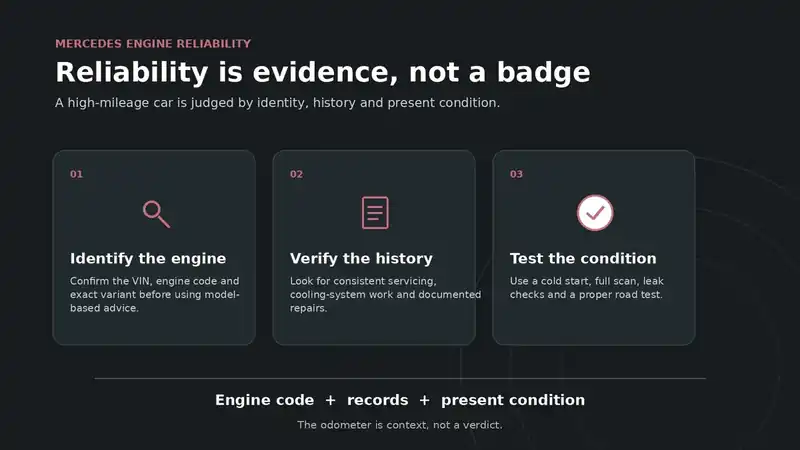
What reliability really means
A reliable engine is not simply one that has accumulated a large odometer reading. A useful assessment asks several different questions:
- Has the core engine remained mechanically sound? Compression, oil pressure, cooling-system sealing and stable operating temperature matter.
- Have the supporting systems been maintained? Fuel delivery, ignition, air metering, wiring, sensors, pumps, hoses and engine controls can determine whether the car is dependable in daily use.
- Is the engine correctly matched to the car being assessed? A family name may cover different capacities, induction systems, production revisions and vehicle applications.
- Is the whole vehicle still a sensible ownership proposition? Transmission condition, electronics, suspension, corrosion, parts availability and previous repair quality can outweigh the reputation of the engine itself.
This is why words such as “bulletproof” and “lasts forever” are misleading. A durable design can survive poor treatment for a time, but neglect still leaves evidence. Likewise, an engine family with a complicated reputation may be a reasonable purchase when its exact version is understood and the individual car has strong records and clean inspection findings.
Mileage is context, not proof
Mercedes-Benz has recognised long-term ownership through its High Mileage Award, with an entry level beginning at 155,000 miles. That programme confirms that high-mileage Mercedes vehicles exist and are worth recognising. It is not a mechanical inspection, a reliability ranking or evidence that every qualifying vehicle reached the distance without repairs.
For a buyer, the odometer should start questions rather than end them. A high number can reflect steady long-distance use with regular servicing, or years of deferred repairs. A low number can be genuine, inaccurate, or the result of a car spending long periods unused. Records, dates, workshop invoices, inspection findings and the way the vehicle behaves from cold are more informative than the number alone.
Look for a history that makes sense as a sequence. Oil and filter services should be supported by dates or invoices, not only verbal assurances. Cooling-system repairs should explain why they were needed and whether the cause was resolved. Major work should identify the parts used and the reason for replacement. Gaps do not automatically condemn a car, but they increase uncertainty and should change the inspection depth and the price you are prepared to pay.
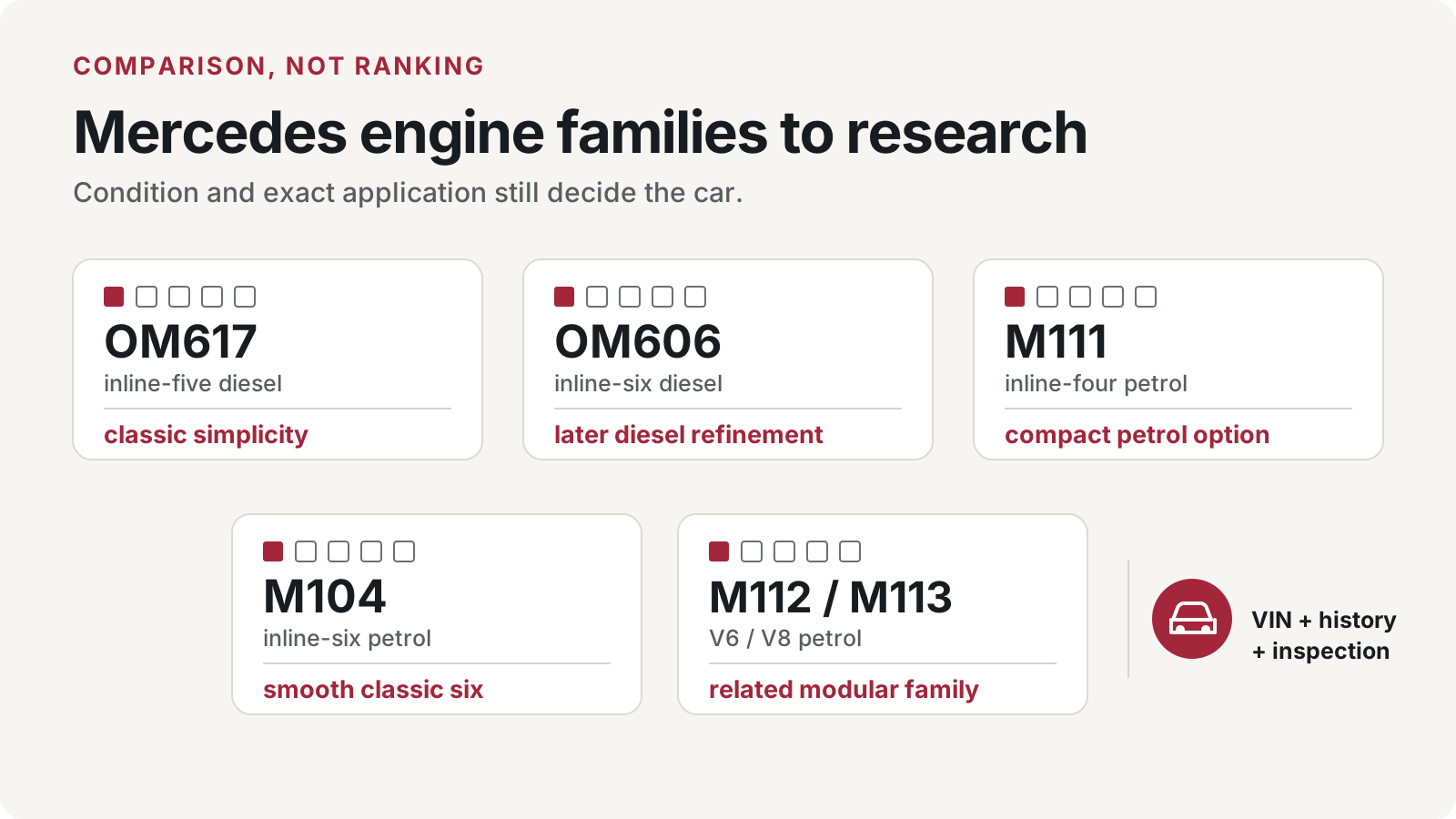
Engine families worth researching
The following shortlist combines older diesel and petrol families that are repeatedly considered by long-term owners. Their inclusion means there is enough technical identity and ownership relevance to justify research. It does not mean every version, installation or surviving example is equally dependable.
| Family | Verified architecture | Why it belongs in the conversation | What to verify |
|---|---|---|---|
| OM617 | Inline-five indirect-injection diesel with mechanically controlled Bosch injection and chain-driven camshaft | Its relatively direct mechanical layout makes cause and effect easier to understand than on a newer emissions-controlled diesel | Cold start, smoke, fuel delivery, leaks, cooling history and the condition of the vehicle around it |
| OM606 | Inline-six diesel with four valves per cylinder, twin overhead camshafts and chain drive | It combines a later multi-valve design with an identifiable mechanical base | Exact naturally aspirated or turbo application, cold start, fuel system, cooling, leaks and ancillaries |
| M111 | Inline-four petrol family used in naturally aspirated and supercharged applications | It gives buyers a compact petrol alternative with broad Mercedes application history | Exact variant, idle quality, cooling stability, oil leaks, wiring, sensors and boost system where fitted |
| M104 | Inline-six petrol family with four valves per cylinder, twin overhead camshafts and chain drive in documented applications | Its smooth six-cylinder layout makes it relevant to classic Mercedes buyers who accept age-related inspection needs | Cooling history, fluid condition, leaks, wiring and application-specific previous repairs |
| M112 / M113 | Related V6 and V8 petrol families with light-alloy construction, three valves per cylinder and chain drive in documented applications | They cover many later Mercedes models and let buyers compare a related V6/V8 ownership generation | Cold start, leaks, cooling, fault memory, ignition and intake behaviour, transmission and the rest of the vehicle |
OM617 diesel
The OM617 is an inline-five indirect-injection diesel family. Mercedes archive data for the 240 D 3.0 application identifies five cylinders in line, a mechanically controlled Bosch injection pump and a double-roller chain driving the overhead camshaft. Those details help explain why an owner can often follow the relationship between fuel delivery, valve operation, temperature and smoke without first navigating a large network of later emissions controls.
That relative simplicity should not be confused with immunity to age. Before valuing an OM617 car for its reputation, see it start from fully cold, note how quickly it settles, observe smoke under different conditions, inspect fuel and oil leaks and confirm that temperature remains stable. The condition of the cooling system, vacuum-operated functions, mounts, transmission and body may shape ownership more than the engine block.
OM606 diesel
The OM606 is an inline-six diesel family. Mercedes archive data for the E 300 Diesel identifies six cylinders in line, four valves per cylinder, twin overhead camshafts and a double-roller chain. It represents a different ownership proposition from the older OM617, with a more developed cylinder head and application-dependent fuel and induction systems.
Do not treat every OM606 as the same engine package. Confirm whether the car has a naturally aspirated or turbocharged application, verify the engine number and production data, then assess cold starting, fuel delivery, cooling stability, oil or coolant leaks and the condition of supporting components. Modified examples need extra scrutiny because increased output can change heat, fuel and transmission demands.
M111 petrol four-cylinder
The M111 is an inline-four petrol family used across different Mercedes applications, including naturally aspirated and Kompressor versions. That range is precisely why the code alone is not enough. The induction system, engine management and vehicle installation can change what must be inspected.
For a used example, listen for a stable cold idle, check for oil and coolant leakage, confirm that operating temperature remains controlled and review stored and current fault records. On a supercharged application, include the boost path, belt drive and related controls. Age-related wiring, connectors and sensors can create symptoms that feel mechanical, so diagnosis should separate an electrical or air-metering fault from internal engine wear.
M104 petrol inline-six
The M104 is an inline-six petrol family. Mercedes archive material for the E 280 application documents six cylinders in line, four valves per cylinder, twin overhead camshafts and chain drive. Its balanced layout and smooth delivery are part of its appeal, but a pleasant test drive does not replace an inspection.
Cooling history deserves particular attention on an older car. Ask whether any overheating event occurred, why cooling components were replaced and whether oil and coolant stayed separate. Check the engine from cold and again after the road test, look for fresh cleaning around leak-prone areas and verify that wiring repairs match the exact application. A repaired issue with clear records can be preferable to a car whose seller denies visible evidence.
M112 and M113 petrol engines
The M112 V6 and M113 V8 belong to a related Mercedes petrol-engine generation. Official archive pages for documented E-Class applications identify light-alloy construction, three valves per cylinder, a single overhead camshaft per bank and chain drive. The shared design relationship is useful, but it does not make the V6 and V8 identical or place every application in the same risk category.
At higher mileage, evaluate the entire powertrain. Cold-start quality, oil and coolant leaks, temperature stability, ignition behaviour, air metering, stored faults, transmission response and previous repair quality all matter. A good engine attached to a neglected transmission, cooling system or electrical network may still be an expensive ownership decision.
Why newer engines are not ranked
The absence of M157, M278, OM642, M271 or M272 from this shortlist is not a declaration that those families are unreliable. Each covers different revisions, production periods, vehicles and supporting systems. A broad list can hide the exact distinction a buyer needs, including component revisions, induction type, emissions equipment, software strategy and the repair history of one car.
Those engines are better handled in engine-specific guides that explain applicability and diagnostic depth. A guide dedicated to one family can distinguish versions, identify the evidence required before parts are replaced and explain which findings apply only to certain production data. Repeating them inside another “best engines” ranking would add overlap without helping the reader.
Service history beats the badge
A credible history is not simply a stamped booklet. It is a set of records that describes what happened to the vehicle and makes the present condition believable.
- Confirm identity first. Match the VIN, production data and engine code to the car. A replacement engine is not automatically a problem, but its origin, compatibility and installation should be documented.
- Read records as a timeline. Look for dates, mileage, parts and reasons for work. Repeated repair of the same symptom can indicate that the cause was never isolated.
- Use the correct specifications. Oil, coolant, filters, spark plugs, belts and service operations vary by engine and vehicle. Apply the Mercedes specification for that exact application rather than a generic rule from another model.
- Investigate overheating evidence. Replaced radiators, pumps, hoses or expansion tanks need context. Cooling-system work can be good preventive maintenance, or evidence of an unresolved overheat.
- Separate maintenance from diagnosis. New coils, sensors or injectors do not prove that the original complaint was correctly diagnosed. Compare the invoice with the present symptom and scan data.
- Check consistency. Wear on pedals, controls, seats, tyres and the underbody should broadly agree with the recorded mileage and claimed use.
Missing records increase uncertainty rather than proving failure. The sensible response is a deeper inspection, a risk allowance in the purchase price, or walking away when the uncertainty cannot be defined.
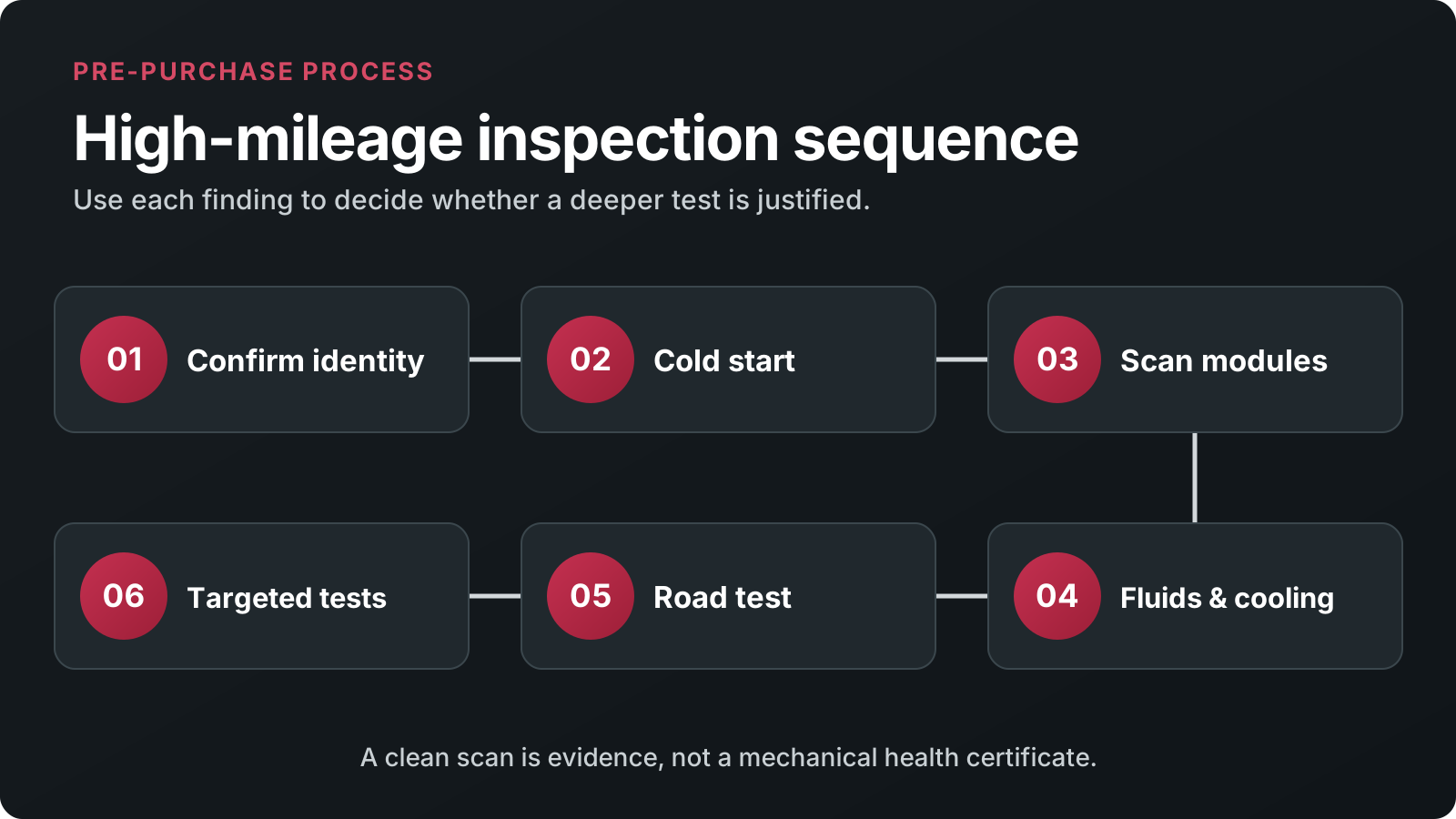
Pre-purchase inspection sequence
- Confirm the vehicle and engine. Decode the VIN, check production data, identify the installed engine and note any undocumented modifications or replacement components.
- Demand a genuine cold start. A warmed engine can hide starting, noise, smoke or idle problems. Check warning-light behaviour before starting and listen through the first minutes of operation.
- Scan all relevant control units. Record current, pending and stored faults before anyone clears them. Review useful live data and compare it with the operating condition in which the symptom occurs.
- Inspect fluids, leaks and cooling. Check oil and coolant condition, evidence of mixing, active leaks, pressure concerns, hose condition and whether the temperature remains stable at idle and under load.
- Complete a road test. Test light and heavier load when safe, observe temperature, response and smoke, assess transmission behaviour and check the hot restart after the drive.
- Escalate to targeted mechanical tests. Compression, cylinder leak-down, cooling-system pressure testing, oil-pressure measurement or borescope inspection should answer a specific concern, not be performed as disconnected theatre.
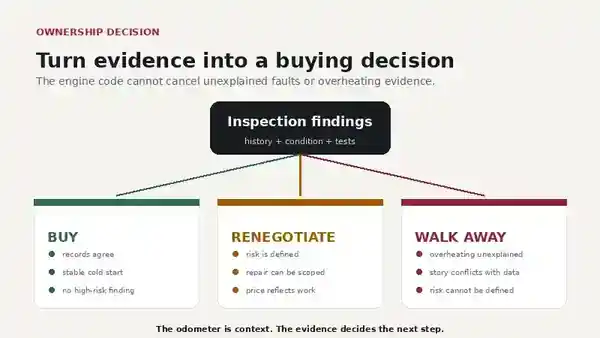
Buy, renegotiate or walk away
A high-mileage Mercedes can be a rational purchase when the evidence is coherent. The records should fit the car, cold-start and road-test behaviour should be stable, and any known defect should have a definable repair path. The purchase price must also leave room for age-related maintenance beyond the engine.
Renegotiation makes sense when the inspection identifies a bounded problem. A visible leak, worn mount, cooling component or sensor fault may be manageable when diagnosis is clear, associated damage has been excluded and parts availability is understood. Use the written findings and repair requirements, not a vague fear of mileage, to discuss the price.
Walking away is reasonable when evidence cannot be reconciled. Examples include unexplained overheating, oil and coolant contamination, serious mechanical noise, inconsistent identity, recently cleared fault memory combined with symptoms, heavy smoke under load, or a seller who prevents a cold start or independent inspection. A famous engine code does not cancel those findings.
High-mileage ownership in the UAE
UAE heat, slow traffic and dust make temperature control, air filtration and electrical condition especially relevant. They do not justify inventing one shorter service interval for every Mercedes. Follow the maintenance schedule and approved fluid specification for the exact model, engine and production data, then adjust inspection frequency according to actual use and condition.
Watch for gradual changes rather than waiting for a warning. A rising operating temperature, coolant loss, a fan that does not respond as expected, hardened hoses, weak battery voltage, oil seepage that reaches belts or mounts, or a heavily loaded air filter should be investigated. Replacing parts without identifying the cause can leave the original risk in place.
For a car that will be kept long term, preserve records and baseline information. Note normal temperature behaviour, oil consumption, cold-start sound, scan status and recurring fluid losses. That history makes later changes easier to recognise and gives a workshop something more useful than a single symptom description.
Need vehicle-specific evidence?
Get the engine checked
When the history is incomplete, the temperature behaviour is uncertain or scan findings need mechanical confirmation, diagnosis should be based on the exact car rather than its engine’s reputation.
Mercedes engine diagnosis and repair should follow the inspection findings.
Common owner questions
Mercedes engine reliability FAQs
Which Mercedes engine is the most reliable?
There is no universal winner. The OM617, OM606, M111, M104 and M112/M113 families are sensible research starting points, but the exact variant, vehicle condition, service history and inspection evidence decide whether a particular car is a good ownership prospect.
Is high mileage bad on a Mercedes?
Not by itself. High mileage increases the importance of records, cooling-system history, oil and coolant condition, fault memory, cold-start behaviour and a road test. A well-documented car can be a better prospect than a lower-mileage example with gaps, overheating evidence or unexplained warning lights.
Does a clean diagnostic scan prove the engine is healthy?
No. A scan can show current and stored electronic fault records, but it cannot by itself prove compression, oil pressure, cooling-system sealing or internal mechanical condition. Use scan data as one part of the inspection.
Are M112 and M113 engines good for high-mileage ownership?
They are reasonable families to research because their related V6 and V8 architecture appears across many Mercedes applications. The decision still depends on the exact engine version, the rest of the vehicle, service records, cold-start behaviour, leaks, cooling stability and diagnostic results.
Why are M157, M278, OM642, M271 and M272 not ranked here?
Their omission is not a verdict. Each spans different revisions, applications and supporting systems, so a generic reliability ranking can hide important vehicle-specific differences. Research the exact engine and production data, then inspect that car.
What should I check before buying a high-mileage Mercedes?
Confirm the VIN and engine code, review dated service and repair records, see the engine start from cold, scan all relevant control units, inspect oil and coolant, check for leaks and pressure concerns, complete a road test and use targeted mechanical tests only when the findings justify them.
Should a worn high-mileage engine be rebuilt or replaced?
Choose only after diagnosis defines the damage and the vehicle-specific options. Compare the confirmed repair scope, parts availability, replacement-engine provenance, installation requirements and the condition of the rest of the car. The odometer alone does not answer the question.
Technical source notes
Engine architecture and programme details were checked against Mercedes-Benz material. These sources verify specifications and the High Mileage Award programme; they do not certify the present condition of any used vehicle.
- Mercedes-Benz USA Classic Center, High Mileage Award
- Mercedes-Benz Public Archive, 240 D 3.0 and OM617.910
- Mercedes-Benz Public Archive, E 300 Diesel and OM606.912
- Mercedes-Benz Public Archive, C 230 Kompressor and M111.975
- Mercedes-Benz Public Archive, E 280 and M104
- Mercedes-Benz Public Archive, E 320 and M112
- Mercedes-Benz Public Archive, E 430 and M113