
7G-Tronic diagnosis · 722.9
Mercedes 7G-Tronic Problems: Jerking, Limp Mode and Delayed Shifts
Jerking, delayed engagement and limp mode can come from fluid, electrical, hydraulic, mechanical or even driveline faults. The useful question is not which 722.9 part commonly fails, but which test separates the possible causes on your car.
Mercedes 7G-Tronic problems such as jerking, limp mode or a delay when you select Drive or Reverse do not automatically mean the gearbox needs replacement. The 722.9 transmission family combines electronic control, hydraulic pressure, a valve body, solenoids, internal speed sensing, a torque converter and mechanical clutch elements. The same driving complaint can begin in more than one of those areas.
The first useful steps are to identify the exact transmission version, reproduce the fault hot and cold, scan the transmission control system and preserve its data before resetting adaptations. Fluid level and specification matter, but so do electrical supply, wiring, live speed and slip values, hydraulic response and evidence inside the pan.
First confirm which transmission is fitted
7G-Tronic is the familiar name for Mercedes-Benz’s 722.9 seven-speed automatic transmission family. Later 7G-Tronic Plus versions belong to the same broad family but are not identical in every internal detail, control strategy, service procedure or fluid requirement. A model badge or registration year is not enough to select parts or fluid.
The workshop should confirm the transmission number and variant from the vehicle data and the unit itself. That prevents a correct procedure for one 722.9 version from being applied to another. It also matters because some Mercedes vehicles use a different transmission even when the dashboard behaviour sounds similar.
| Reference you may see | What it tells you | What still needs confirming |
|---|---|---|
| 7G-Tronic | The original generation of the Mercedes seven-speed automatic family commonly associated with 722.9 | Full transmission identification, vehicle application, software level, service design and approved fluid |
| 7G-Tronic Plus | A later development of the 722.9 family with changes intended to improve efficiency and operation | The exact variant and vehicle-specific repair information; “Plus” does not make every component or fluid interchangeable |
| 722.9 on a scan or data record | The transmission family has been identified | The complete unit number, control-unit data, production configuration and any applicable technical instructions |
| “Seven-speed Mercedes gearbox” | Only a general description | Whether the vehicle actually has 722.9 rather than another seven-speed transmission |
Read the behaviour before naming a part
Describe exactly when the fault happens. “It jerks” is much less useful than “the 2–3 shift is firm only when warm” or “Reverse takes three seconds to engage after an overnight start.” The pattern determines which values and circuits need attention.
| What you notice | Areas to prioritise | Evidence needed before repair |
|---|---|---|
| A firm or jerky change on one shift | Adaptation and fill behaviour, solenoid or valve-body control, speed signals, software and internal clutch operation | The exact gear change, load and temperature, plus fault memory and live data during that event |
| Several harsh shifts after the warning appears | Failsafe operation caused by an electrical, sensor, pressure or internal fault | Uncleared VGS/TCU codes, freeze data, electrical supply and circuit tests |
| Delay selecting Drive or Reverse | Fluid level or leak, pressure build-up, valve-body leakage, pump output or worn clutch elements | Timed engagement hot and cold, correct fluid check, leak inspection and pressure or slip evidence |
| Engine speed rises between shifts | Low hydraulic holding pressure, clutch slip or an incorrect control response | Target versus actual gear, speed and slip data; fluid condition and pan evidence |
| Shudder at a steady road speed | Torque-converter lock-up, fluid condition or a non-transmission vibration from the engine, mounts or driveline | Converter slip data and a road test that separates lock-up behaviour from vehicle-speed or engine-speed vibration |
| A jolt as the car stops or pulls away | Transmission control, mounts, propeller shaft, differential or another driveline component | A physical driveline inspection alongside transmission data; the sensation alone does not locate the fault |
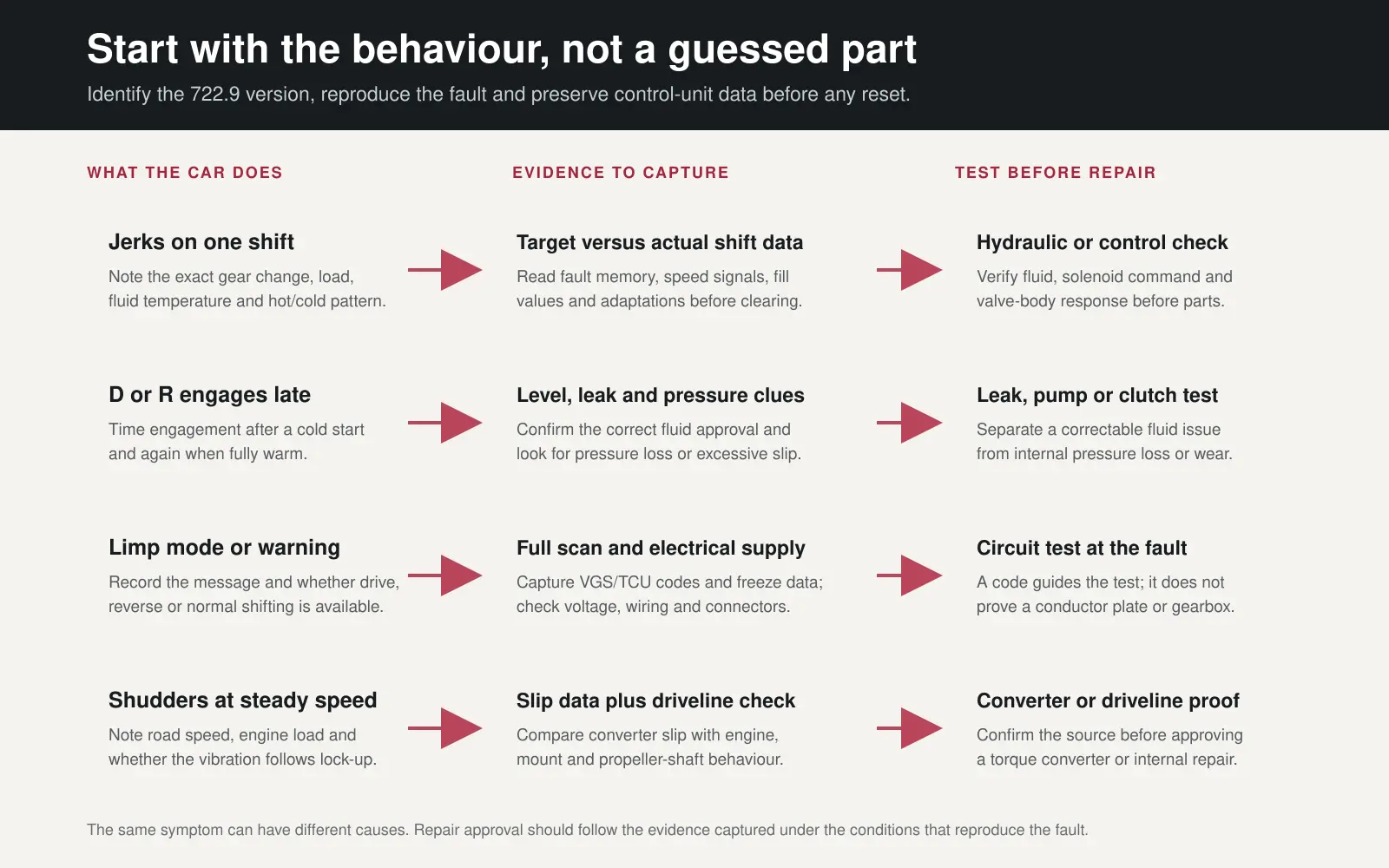
Why a 7G-Tronic can jerk, hesitate or enter limp mode
Fluid level, leaks or the wrong approved fluid
The transmission uses fluid to create hydraulic pressure, lubricate moving parts and transfer torque through the converter. A leak or incorrect level can affect pressure and engagement. Fluid that does not match the required Mercedes-Benz approval can change friction behaviour. The correct approval and checking procedure depend on the actual 722.9 version, so colour or a generic “ATF” label is not enough.
Fluid condition can support a diagnosis, but dark fluid alone does not identify the failed component. A pan inspection is more useful when it considers the type and amount of debris, the filter, leak points and the behaviour recorded before the pan was removed.
Conductor plate, internal speed sensing and control electronics
The transmission control system needs reliable speed, temperature and position information to choose a gear and control pressure. A fault involving an internal speed signal, the conductor-plate assembly, the transmission control unit, its connector, power supply or wiring can trigger limited operation. The fault code tells the technician which signal or condition was recorded; it does not, on its own, prove which physical part caused it.

Valve-body or solenoid control
Solenoids regulate hydraulic circuits inside the valve body. Wear, contamination, sticking valves or an incorrect command can create a harsh, delayed or slipping shift. Because an electrical command, hydraulic response and mechanical clutch are linked, replacing a valve body without comparing commanded and actual behaviour can miss the real cause.
Torque converter or internal wear
A torque-converter lock-up fault may feel like shudder, flare or poor acceleration under particular conditions. Worn clutch elements, seals, bearings, pump parts or gear-train components can also cause pressure loss, slip, noise or debris. These are mechanical possibilities, not conclusions to draw from one symptom.
Engine, voltage or driveline faults that feel like gearbox trouble
An engine misfire, unstable torque signal, weak electrical supply, damaged mount, propeller-shaft problem or differential play can be felt during a shift or stop. These areas should be investigated when the fault pattern and full-vehicle scan point beyond the transmission. Checking them prevents a transmission repair from being approved for a vibration or jolt created elsewhere.
Checks you can make without disturbing the evidence
-
Write down the exact behaviourRecord the selected gear, the shift involved, whether the engine speed rises, the dashboard message and whether the problem appears cold, warm or after a long drive.
-
Check beneath the parked carLook for a fresh oily leak without crawling under an unsupported vehicle. A leak needs locating; do not add an unknown fluid simply because the transmission feels different.
-
Compare Drive and Reverse engagementWith the brake applied in a safe, stationary location, note whether one direction takes noticeably longer to engage. Do not repeatedly shift back and forth to force the fault.
-
Keep the warning informationPhotograph the dashboard message and avoid clearing fault codes before diagnosis. If the car returns to normal after a restart, the stored event may still contain the most useful evidence.
-
Bring the service historyRecords can show whether the pan, filter or fluid has been serviced and what material was used. They are more reliable than assuming the fluid is original or recently changed.
Do not reset adaptations, disconnect the battery to erase a warning or use an additive as a diagnostic shortcut. Those actions may alter the symptom or remove information without repairing the cause.
What a proper 722.9 diagnosis should include
Daimler workshop guidance for 722.9 shift-quality complaints calls for control-unit records and EEPROM data to be read before repair or adaptation work. That principle matters: capture the evidence first, then change one condition at a time.
1. Confirm the unit and reproduce the complaint
The technician identifies the transmission variant, checks the history and road-tests the car under safe conditions. Temperature, selected gear, load and the exact moment of the fault are recorded. A complaint that appears only hot should not be judged from a short cold workshop check.
2. Scan before clearing or resetting
The full vehicle is scanned, with particular attention to the VGS or transmission control data. Stored and current codes, event information, software status and adaptation or fill values are preserved. Engine and power-supply faults are considered because the transmission relies on accurate torque and voltage information.

3. Check electrical supply and the indicated circuit
Battery and charging voltage, grounds, fuses, connectors and wiring are checked where relevant. If a code concerns a speed signal, solenoid or communication path, the circuit is tested rather than treating the code description as a parts order.
4. Verify the fluid under the specified conditions
The fluid approval, level procedure and temperature window must match the actual transmission. Leak points and connector condition are inspected. If the pan is removed, the filter and debris are assessed before the evidence is cleaned away.

5. Compare commands with the mechanical response
During a controlled test, the technician may compare input and output speeds, target and actual gear, converter slip, temperature and clutch-fill or adaptation data where supported. If the control request looks correct but the response is not, hydraulic or mechanical testing becomes more important.
6. Verify the repair in the original conditions
Software updates, adaptation procedures and relearning should be applied only when the vehicle-specific repair information calls for them. The final road test must reproduce the original hot or cold condition and confirm normal engagement, shift quality and fault status.
| Test or evidence | What it can show | What it cannot prove alone |
|---|---|---|
| Fault-code scan | The circuit, signal or operating condition recorded by a control unit | That the component mentioned in the code is the failed part |
| Adaptation and fill data | How the control system has been compensating under particular conditions | The exact internal wear point without corroborating tests |
| Fluid level and condition | Incorrect level, wrong material, contamination or evidence that supports further inspection | That a fluid service will cure an electronic or worn mechanical fault |
| Live speed and slip data | Whether commanded shifts, clutch response or converter lock-up differ from expected behaviour | The physical cause without circuit, hydraulic or mechanical confirmation |
| Pan and filter inspection | The type and amount of material present and whether the filter or pan reveals a service concern | Every possible valve-body, control or driveline fault |
| Hydraulic pressure testing | Whether pressure is available and responds under defined conditions | Which electronic command is wrong unless the scan data is considered too |
When a fluid service may help
A fluid, filter or pan service is justified when the maintenance history and vehicle-specific schedule call for it, when a leak or incorrect level is being corrected, or when inspection shows that the installed fluid does not meet the required approval. It can also be part of a measured diagnostic plan when the evidence supports it.
It is not a guaranteed cure for jerking or limp mode. A service cannot repair a failed circuit, damaged speed-sensing system, worn valve body, slipping clutch or torque converter. Nor should a forceful “flush” be prescribed before the unit, fluid requirement and fault evidence are understood. The repair order should state the exact fluid approval and work performed.
Can you keep driving?
If the transmission engages normally, there is no leak, smell, noise or active slipping, and the car has only produced one mild firm shift, drive gently only as far as needed to arrange diagnosis. Avoid towing, hard acceleration and repeated attempts to make the fault happen.
Stop and recover the car if it cannot maintain drive, flares between gears, bangs repeatedly into gear, overheats, leaks heavily, grinds or cannot select Drive or Reverse. Limp mode is a protective operating state, not permission to continue indefinitely. The safest choice depends on the actual behaviour and any dashboard instruction.
The repair should follow the evidence
A sensible estimate should name the confirmed fault, the evidence behind it, the work included, any programming or adaptation required and how the result will be verified. “Needs a gearbox” without that chain of evidence is not a complete diagnosis.
Mercedes transmission diagnosis in Al Quoz
Bring the symptom, not a guessed part
Send the model, VIN or year, dashboard message and a short description of when the shift problem occurs. MercGarage can identify the transmission and test the evidence before recommending service or repair. See our Mercedes transmission repair service in Dubai for workshop options.
7G-Tronic questions
Is every Mercedes seven-speed automatic a 722.9?
No. 7G-Tronic is commonly associated with the 722.9 family, but “seven-speed Mercedes gearbox” is only a general description. Confirm the transmission number and variant from the vehicle data before selecting fluid, parts or a test procedure.
Does jerking mean the conductor plate has failed?
No. A conductor-plate or internal speed-signal fault is one possibility, but jerking can also involve fluid level or specification, valve-body control, solenoids, software, clutch operation, the torque converter, engine torque or driveline movement. Codes and circuit tests must support the repair.
Can a transmission fluid change fix 7G-Tronic jerking?
It may help when incorrect level, an active leak, unsuitable fluid or a service-related condition is part of the cause. It cannot repair a failed electrical circuit, worn valve body, slipping clutch or damaged torque converter. Diagnose the behaviour before treating a fluid service as the cure.
Why does a 7G-Tronic go into limp mode?
The control system limits operation when it records a condition that could affect safe or reliable shifting. The trigger may be electrical, sensor-related, hydraulic, software-related or mechanical. Limp mode confirms that the system reacted to a fault; it does not identify the failed part.
Should 722.9 adaptations be reset to cure harsh shifts?
Not as a first step. Adaptation values and control-unit records are diagnostic evidence and should be read before they are changed. A reset does not repair wear or an electrical fault, and the correct relearning or adaptation procedure depends on the confirmed repair and vehicle-specific instructions.
What causes a delay when selecting Drive or Reverse?
Possible causes include incorrect fluid level, a leak, slow pressure build-up, valve-body leakage, pump wear or worn clutch elements. Timing the engagement hot and cold, checking the correct fluid conditions and comparing pressure or slip evidence helps separate them.
Can I drive a Mercedes that is in transmission limp mode?
Only a very short, gentle trip may be reasonable if drive is stable, there is no slipping, leak, noise, smell or overheating warning, and the dashboard does not instruct you to stop. Recover the car if engagement is unreliable or any of those higher-risk symptoms is present.
How can I tell 7G-Tronic from 7G-Tronic Plus?
Do not rely on the gear count or model year alone. Use the VIN-linked vehicle data and complete transmission identification. That information determines the version, approved fluid, service method, software and applicable technical instructions.
Technical references
Daimler’s 722.9 workshop-guide notice identifies the factory reference for 7G-Tronic and 7G-Tronic Plus. The linked document is an ordering notice, not the complete diagnostic procedure.
Daimler guidance for 722.9 shift-quality complaints calls for transmission control-unit records and EEPROM data to be read before repair or adaptation work.
Mercedes-Benz Operating Fluids sheets 236.14 and 236.15 illustrate why fluid approval must be matched to the identified transmission and vehicle rather than chosen from a generic ATF label.