Mercedes guide
E55 AMG Maintenance for W210 and W211
The E55 AMG needs a service plan matched to its generation and the car’s actual history. The W210 uses a naturally aspirated M113 V8, while the W211 uses the supercharged M113K. Both have a timing chain, so a generic timing-belt replacement interval does not apply. Start…
The E55 AMG needs a service plan matched to its generation and the car’s actual history. The W210 uses a naturally aspirated M113 V8, while the W211 uses the supercharged M113K. Both have a timing chain, so a generic timing-belt replacement interval does not apply.
Start with the VIN, the maintenance booklet, the service indicator and dated invoices, then inspect the car before adding overdue work.
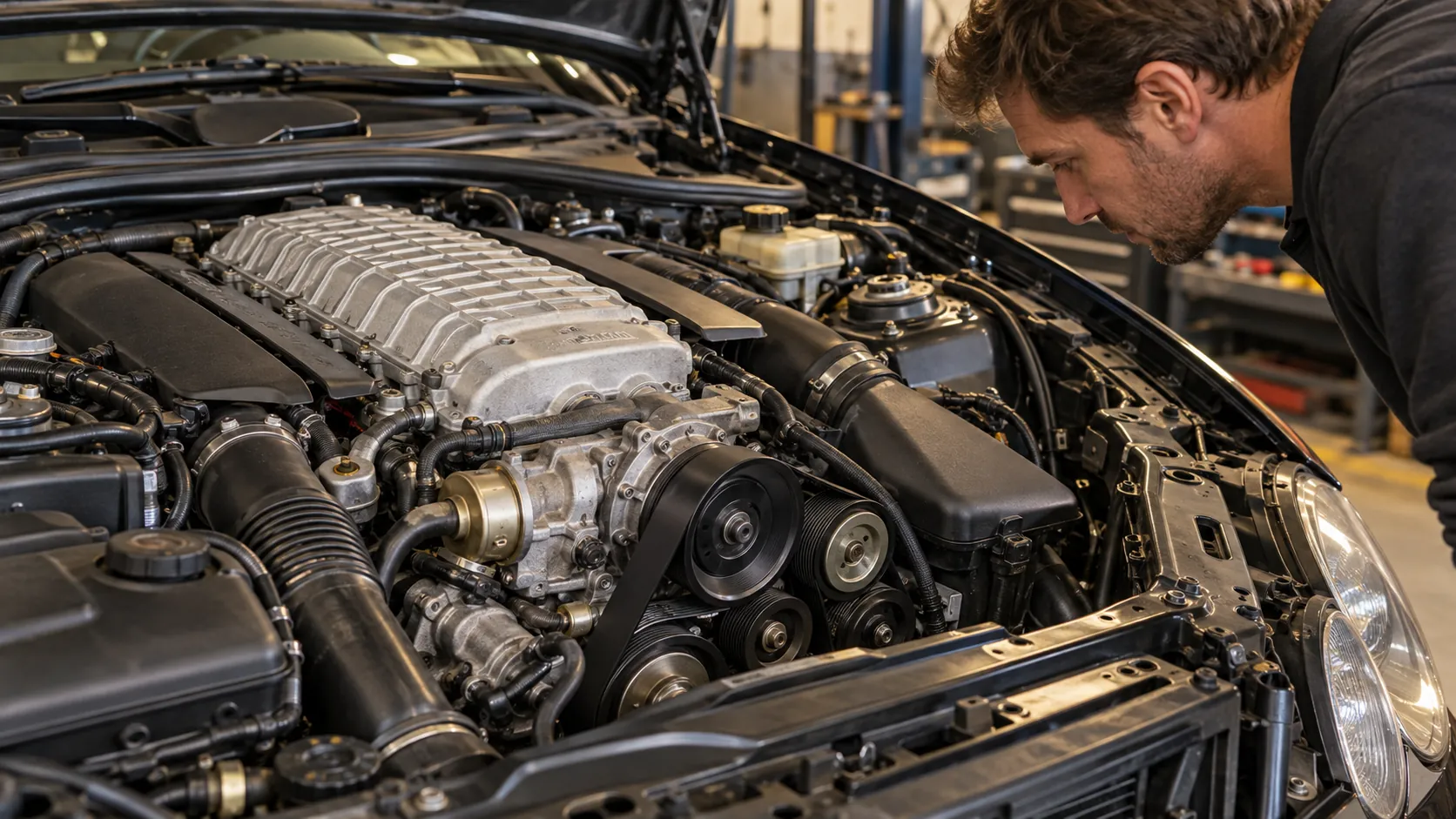
W210 and W211 E55 engines need different checks
The badge spans two distinct E-Class generations. Mercedes-Benz’s model history identifies the 210-series E55 AMG with the M113 V8 and the later 211-series E55 AMG as the higher-output successor. The W211’s supercharger adds an external drive and charge-air cooling considerations that do not belong in a W210 checklist. Neither standard engine is a turbocharged E55.
| Vehicle | Induction and timing drive | Maintenance distinction |
|---|---|---|
| W210 E55 AMG | Naturally aspirated M113 V8 with timing chain | Check conventional engine, cooling, brake, suspension and fluid records. No factory supercharger drive. |
| W211 E55 AMG | Supercharged M113K V8 with timing chain | Inspect supercharger belt, pulleys and relevant cooling hardware as well as the ordinary service items. |
Confirm the chassis and engine from the VIN before ordering parts. Market specification, model year and previous modifications can change a particular car’s equipment. Mercedes-Benz’s E-Class model history explains the change from the 210 to 211 series, and the exact vehicle’s maintenance booklet remains the source for due work.
Check the fluids, brakes, cooling and running gear
An old AMG may have low mileage yet still have overdue time-based work. Compare the dashboard reminder with the booklet and dated invoices. A reset proves only that a reminder was reset, so ask what parts and fluids were actually changed. If the history is incomplete, inspect first and quote the missing work separately.
- Engine oil and filter — Check the correct Mercedes-Benz approval and viscosity for the identified engine and market. Use the applicable service schedule and time since the last documented change rather than a universal 5,000-mile rule.
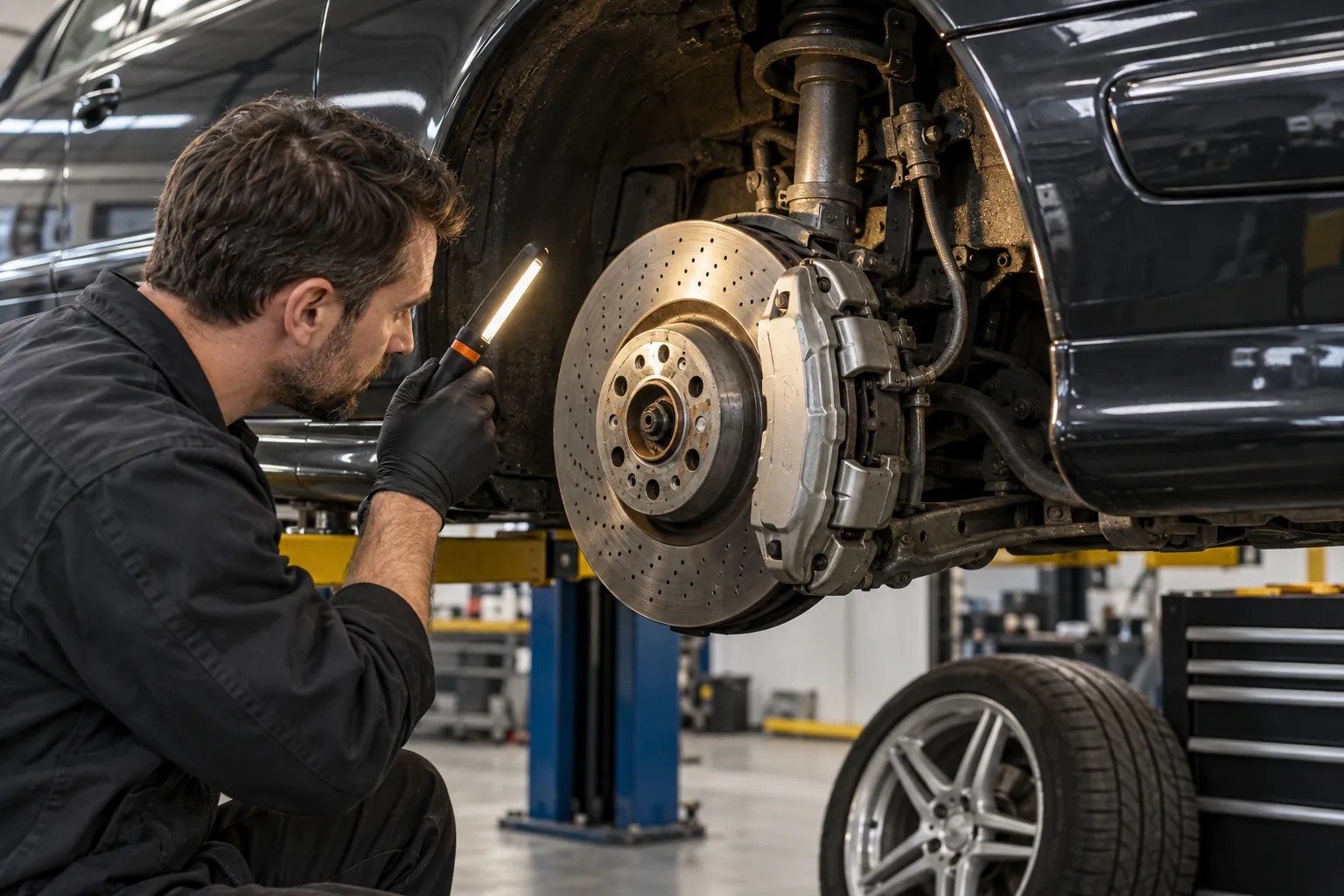
- Brake system — Inspect pad and disc condition, hoses, leaks and the date of the last brake-fluid exchange. A soft pedal, brake warning or reduced braking requires prompt professional attention. The W211’s Sensotronic Brake Control must be handled with the proper service procedure and equipment.
- Transmission and final drive — Confirm the gearbox variant, fluid specification and service history before planning fluid and filter work. Rough shifting deserves diagnosis instead of an automatic flush.
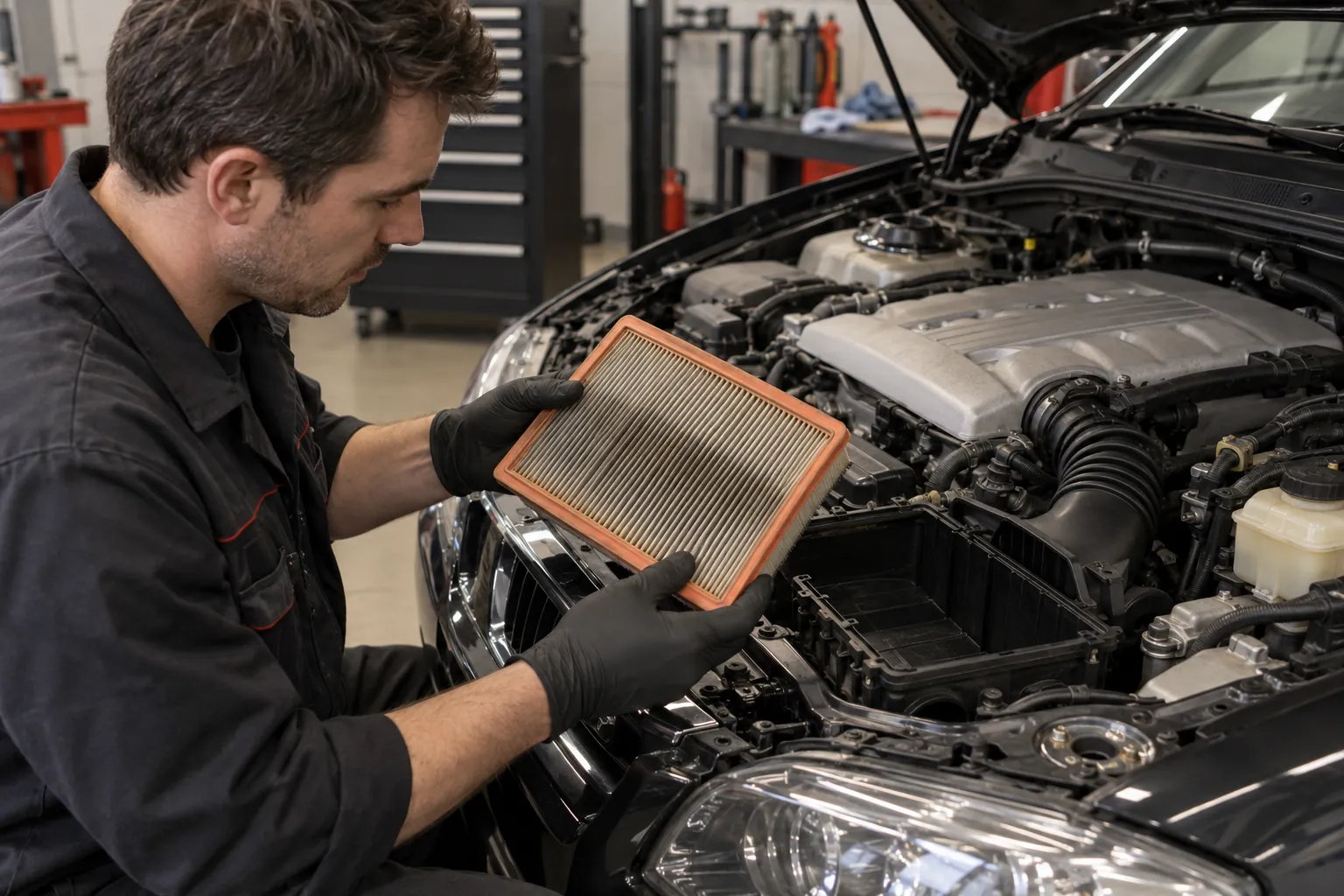
- Cooling and air intake — Check coolant condition, hoses, radiator airflow, leaks and the engine air filter. Dust can justify closer filter inspection in Dubai, but it does not establish a fixed replacement interval for every car.
- Tyres, steering and suspension — Measure tread and inspect tyre age, pressures, wear pattern, bushes and leaks. Check the actual tyre sizes and directional or staggered fitment before suggesting rotation.
- Ignition and electrical supply — Review plug records and assess battery and charging condition when symptoms or test results warrant it. A warning lamp needs fault-specific diagnosis.
For a car with unknown history, prioritise safety and due fluids before optional refinements. Mercedes-Benz’s owner manual library is a starting point for locating the relevant manual. The service booklet and VIN-specific workshop information determine the exact operations and timing.
Prioritise maintenance when service records are missing
Make a short record for each item with the date, odometer reading, fluid specification, parts used and invoice number. A stamp or dashboard service message alone cannot tell you whether brake fluid, transmission fluid or a filter was changed.
If the booklet is missing, ask the workshop to identify the model year and equipment from the VIN, inspect the car and give you a baseline report. That turns an uncertain history into a plan without assuming every component needs replacement.
Prioritise a braking, tyre, steering or cooling fault that affects safe use. Next, establish which time-based fluids and scheduled operations have reliable evidence. Inspect belts, filters, hoses and suspension parts for condition. A small leak may need tracing and monitoring, while a major leak needs repair.
Keep the diagnosis and the proposed repair on separate lines of the estimate so a symptom does not quietly become a parts order.
If a previous owner fitted different wheels, a pulley or other performance hardware, record it before choosing parts or interpreting the service schedule. The VIN identifies the original build, but it cannot confirm later modifications. Photos and old invoices are useful when the fitted part differs from the catalogued one.
Distinguish the timing chain from external drive belts
The M113 and M113K use an internal timing chain, not a scheduled timing belt. Inspect or diagnose the chain drive if there is an abnormal rattle, timing-related fault or other evidence. Do not treat mileage alone as a confirmed chain failure.
The visible accessory and, on the W211, supercharger belts are different parts. They can crack, slip or develop pulley and tensioner noise. A technician can assess belt condition with the engine stopped and determine the cause before replacing components. No owner should put hands near a running belt drive.
If a seller says the “timing belt was done,” ask for the invoice and part numbers. The job may have involved an external drive belt, a pulley or a tensioner rather than the internal chain. This distinction changes what was actually serviced and what still needs inspection.
Conversely, an external belt replacement is not evidence that a chain concern was investigated.
Check the W211 supercharger drive and cooling system
A standard W211 E55 uses a mechanically driven supercharger. A loss of power, unusual belt-area noise or a cooling concern calls for diagnosis of the relevant drive, air path and cooling system. These symptoms do not establish that the supercharger itself has failed.
The W210 has no factory supercharger, and neither generation should be given a routine turbo inspection in this guide.
Software tuning, pulley changes and exhaust changes are modifications, not scheduled maintenance. They should never be presented as necessary care or as a substitute for repairing a fault. Ask for the vehicle’s modification history because it can change parts, cooling demands and diagnostic assumptions.
On a supercharged car, compare a complaint with the circumstances in which it appears. A noise on startup, a loss of power after repeated acceleration and a high engine-temperature warning may point to different checks. Record the dashboard message and whether the symptom appears at idle, under load or only when hot.
The technician can then inspect the external drive, read fault data and assess the appropriate cooling circuit before naming a failed part. A cooling warning calls for prompt action rather than further hard driving to reproduce the fault.
Brake, cooling and oil-pressure warnings need prompt attention
Do not wait for the next service if the car overheats, loses coolant, develops an oil-pressure warning, brakes poorly or has a tyre defect. Stop in a safe place and arrange professional assessment.
A minor seep, uneven tyre wear or a new belt noise still merits a timely check, but the repair choice depends on inspection rather than a list of “common failures.”
The W211’s Sensotronic Brake Control adds another reason to take brake messages literally. Mercedes-Benz issued a recall notice for certain 2003 to 2005 E-Class vehicles concerning a possible shift to hydraulic backup mode. That notice does not establish that every E55 has an open recall.
Check the exact VIN and market with an authorised Mercedes-Benz source, and have a qualified technician investigate any brake warning before further use. Ordinary pad wear and a system fault are different findings.
When planning work, ask for a written division between due maintenance, condition-based repairs and optional upgrades. The cost depends on the identified engine and equipment, parts choice, previous service, and what an inspection finds. Request an itemised quotation that identifies parts, labour and VAT before deciding which work to approve.
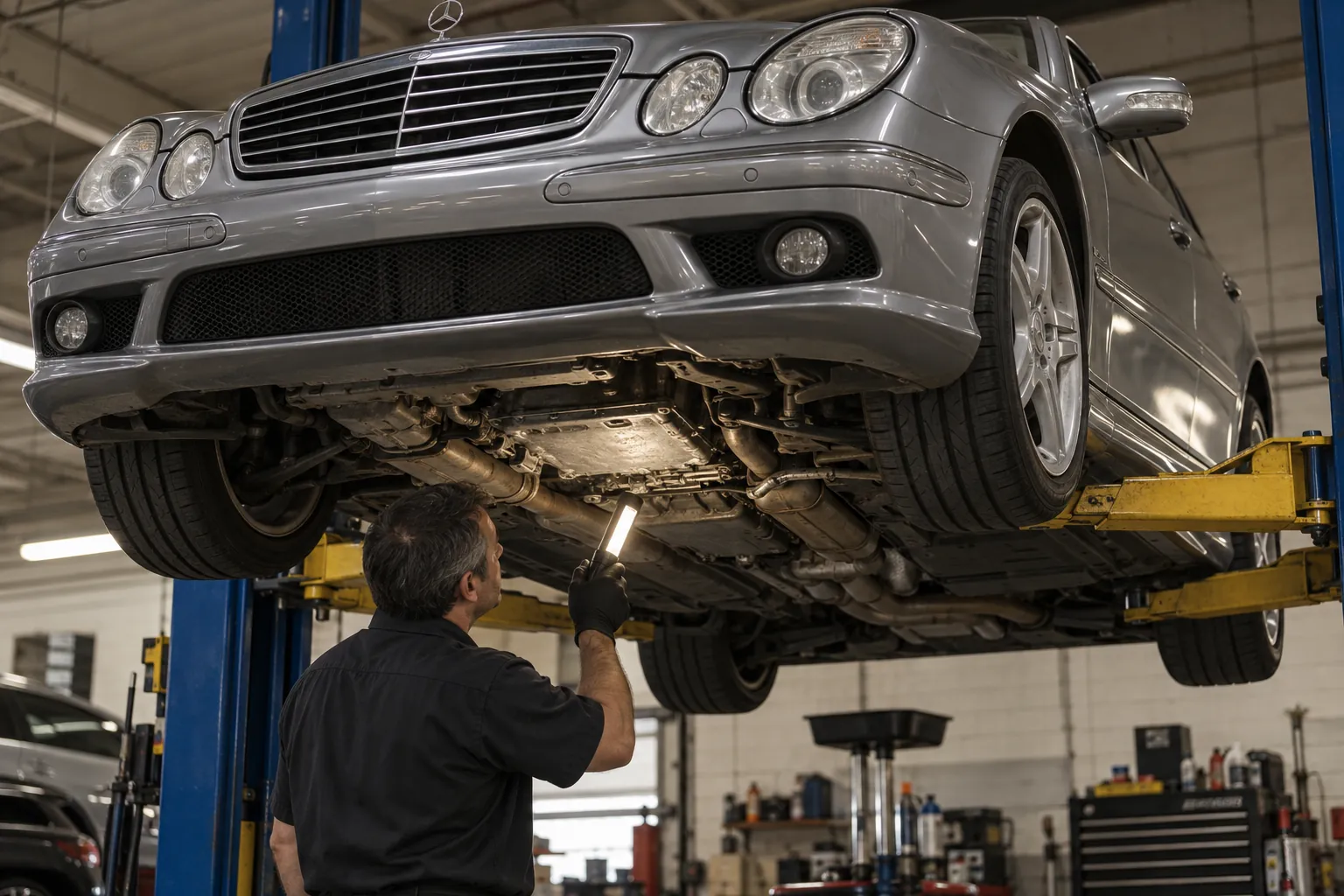
E55 AMG maintenance questions for both generations
Does an E55 AMG need a scheduled timing-belt change?
No. The standard W210 M113 and W211 M113K engines use timing chains. The accessory and W211 supercharger belts are external parts that need condition checks. If an invoice says “timing belt,” confirm the actual part and work before assuming the chain was serviced.
Can the dashboard reminder confirm which fluids were changed?
No. It indicates service timing, but a reset is not a record of the work done. Compare the vehicle’s booklet and dated invoices, then ask the workshop to identify missing fluid history against the VIN and inspect before quoting.
Is a W211 supercharger upgrade part of maintenance?
No. Tuning or a different pulley is an optional modification. A noise, loss of power or cooling complaint needs diagnosis of the fitted drive, air path and cooling components first. Tell the technician about any existing modification.
What if a W211 shows an SBC brake warning?
Treat it as a brake-system concern, not a routine service reminder. If braking feels reduced or the display tells you to stop, pull over safely and arrange professional help. A qualified technician should read the exact message and check the VIN for applicable service information or recall work.
Bring the right details for an E55 service quote
MercGarage is an independent Mercedes workshop at 39, Al Quoz 4, Dubai. Share the VIN, mileage, model year, dashboard message and service invoices so we can compare due maintenance with the car’s condition. See our E55 service page and ask for an itemised quotation before authorising work.