Mercedes guide
Mercedes E300 Service Schedule and Cost Guide
Plan Mercedes E300 servicing in Dubai by VIN, time and distance. See itemised cost guidance, fluid decisions and when a fault needs diagnosis.
An E300 service is due according to the maintenance information for the exact car, using both elapsed time and distance. Start with the VIN, model year, original market, dashboard message and dated invoices. Separate scheduled work from a driving fault that needs diagnosis.
Service A and B are recurring visits, but additional work changes with equipment. A low-mileage car can have time-based work due. The maintenance booklet and vehicle-specific information decide what belongs on the invoice.
Identify the E300 before choosing a service schedule
Mercedes has used the E300 name across different E-Class generations and markets. A W212, W213 and newer W214 should not receive one copied checklist. The separate E 300 e plug-in hybrid has further equipment and service considerations. Check the VIN and fitted powertrain rather than assuming every car called E300 has the same engine, gearbox or fluid circuits.
For a Dubai owner, three pieces of information make the next quote much more useful.
- Vehicle identity includes the VIN, build year and market specification. A registration year can differ from the production year.
- Maintenance evidence includes the booklet, digital record and dated invoices. A reminder reset is not proof that brake fluid, a filter or gearbox oil was changed.
- Current condition includes the exact dashboard message, leaks, noises and how the car drives. A fault may need its own inspection alongside due maintenance.
The Mercedes-Benz owner manual library can help locate the appropriate manual. An example from another market is useful for understanding Service A and B, but it cannot replace the booklet and service data for an imported UAE vehicle.
Check an imported car with incomplete service history
An imported E300 may have records from another market. Compare its VIN and dated invoices with the applicable maintenance information. A reset reminder does not prove an operation was completed.
If records are missing, ask for an inspection and a written list of gaps. Filter condition or a leak can be checked, but appearance cannot date a sealed fluid. Agree what is due or safety-critical before authorising more work.
Use time and distance for Service A and B
Mercedes-Benz describes Service A and B as recurring maintenance visits. In its US owner information, Service A includes oil and filter replacement, fluid-level and tyre-pressure checks, a brake inspection and a maintenance-counter update. Service B adds a cabin filter and brake-fluid exchange to the listed checks. That official A and B description illustrates the distinction, not an E300-specific UAE interval.
Follow the car’s applicable time-and-distance schedule, with whichever limit becomes due first. Do not substitute a universal 6,000- or 10,000-mile rule for the vehicle information. Ask a workshop to review severe-use conditions against the relevant Mercedes instructions and actual usage.
What to confirm when the service reminder appears
Read the full message and record the date and odometer reading. The letter or number shown may indicate the visit type or additional operations, depending on the model. Compare it with the booklet and work already documented. Ask for an itemised list of what is due now, what was recently completed and what remains uncertain.
Do not reset the display to make a warning disappear before the work is recorded. The reset is an administrative step after a completed service. It does not inspect a leak, test a battery or identify why an engine warning is on.
How Dubai use affects inspection without inventing intervals
Heat, dust, short trips and long idling can justify closer condition checks, especially for filters, tyres, cooling and electrical supply. They do not prove that every E300 needs oil twice a year or a coolant or transmission flush at a round mileage. Record your use pattern and ask which manufacturer instruction, observed condition or dated history supports any earlier work.
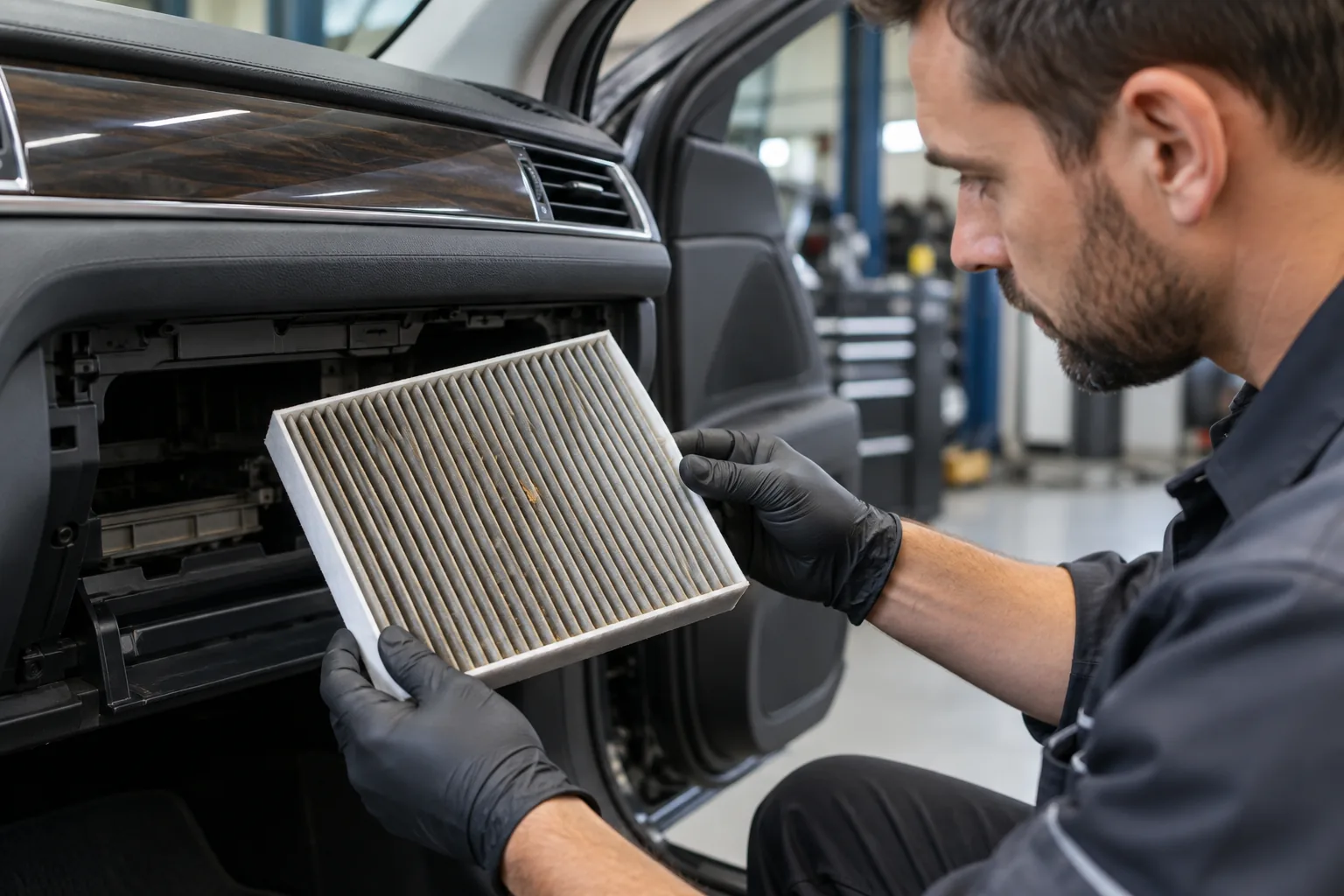
For example, a visibly restricted cabin filter can explain poor airflow, while warm air at the vents may require a separate AC performance and leak assessment. A dusty filter is not evidence that refrigerant should be topped up. Repeated coolant loss likewise calls for diagnosis before a scheduled refill is quoted as the solution.
Separate routine tasks from condition-based repairs
An E300 visit can contain scheduled maintenance, wear-item decisions and fault diagnosis. Keeping those lines separate makes the estimate easier to approve and the final invoice more useful.
| Type of work | What makes it due | What the invoice should say |
|---|---|---|
| Scheduled oil and filter service | The time, distance and vehicle-specific service requirement | Approved oil, quantity, filter, seals, labour and level check |
| Additional scheduled items | The exact booklet, maintenance record and fitted equipment | Each filter, fluid or spark-plug operation separately identified |
| Wear items such as brakes and tyres | Measured condition, safety requirement and compatible specification | Inspection finding, part choice and proposed replacement |
| Fault diagnosis and repair | A symptom, warning, leak or abnormal test result | Diagnostic charge, evidence and separate repair authorisation |
A service visit should include relevant checks, but a diagnostic scan is not a mandatory cure for every concern. A fault code points to a system for testing and does not prove that a named component needs replacement. Ask the technician to explain a recommendation in terms of the actual finding.
Budget for known E300 work without guessing
As checked on 29 September 2026, MercGarage’s published E300 oil-service page gives a planning range of AED 550–850 including 5% VAT for approved oil, compatible filter, routine seals, labour, final level and serviced-area checks. It excludes fault diagnosis, leak repair and additional due parts. The actual engine and product approval still need confirmation.
Its transmission fluid service page gives AED 950–1,800 including labour and 5% VAT for a common applicable 7G or 9G fluid-and-filter service. It depends on the identified gearbox, fluid quantity, filter or pan assembly and access. It is not a standing E300 interval or a promise to fix slipping.
| Budget line | Planning amount and scope | What changes the total |
|---|---|---|
| Routine oil and filter service | AED 550–850 including 5% VAT for the scope above | Fitted engine, oil approval, quantity and filter choice |
| Applicable 7G or 9G fluid and filter service | AED 950–1,800 including labour and 5% VAT for the stated service | Gearbox, pan or filter kit, fluid quantity and access |
| Service A or B additions | Itemised quote after the VIN and due operations are checked | Cabin filter, brake fluid, plugs and other items actually due |
| Brakes, AC or fault repair | Separate inspection and written quote before work | Measured wear, leak or diagnosed fault, parts and labour |
A minor or major package label is not a complete price comparison. Ask for the total, what is included or excluded, and the VAT treatment before approving a job. An oil-only quote and a Service B quote may cover different work.
Keep a separate contingency for repairs. If a worn brake part or leak is found, request the finding, urgency and itemised price. Compare quotes line by line, including filters, brake fluid, consumables, record updates and VAT. A warning needs a separate diagnostic charge and approval before parts are replaced.

Confirm each fluid before authorising extra work
Each fluid circuit has its own specification and procedure. A scheduled fluid exchange differs from a flushing operation, and an abnormal symptom may need diagnosis rather than an exchange. There is no single fixed E300 transmission or coolant flush mileage, or automatic AC refrigerant top-up, that fits every car.
- Engine oil requires the approval and quantity for the fitted engine, plus an appropriate filter. A pressure warning or repeated top-up needs investigation.
- Brake fluid is time-sensitive according to the vehicle’s maintenance instruction. A soft pedal, leak or serious brake warning needs safety assessment before routine fluid work.
- Transmission fluid depends on the identified gearbox and service record. A planned drain and refill differs from a machine or chemical flush. Slipping or harsh engagement needs testing first.
- Coolant requires the approved mixture and procedure when replacement is due or part of a repair. Overheating is a fault to diagnose, not a reason to order an automatic flush.
- AC refrigerant is not a consumable that must be topped up every service. Weak cooling calls for performance and leak checks before charging work.
If the car displays an overheating warning, stop safely and follow the exact manual. Never open a hot pressurised cooling system. If braking feels abnormal, follow the display and arrange qualified help. These decisions take priority over an ordinary appointment.
Ask why a proposed fluid operation is due
Ask which vehicle-specific instruction, record or observed condition supports the fluid work. Confirm the approval, quantity, method and included filter, pan or seals. A drain and refill should be named clearly. “Flush” can describe different procedures, so establish what will happen before agreeing. Keep that detail on the invoice.

Choose compatible parts by specification and evidence
A category alone cannot establish the quality of a filter, brake part or electronic component. For the VIN, compare the applicable part number, approval, fit, documented quality, warranty and price. An oil’s Mercedes approval matters more than brand or viscosity alone.
The estimate should name the chosen part and operation. Some jobs require seals, an approved brake procedure or programming. Check these details rather than assuming every non-genuine part is unsuitable.
Diagnose reduced power before replacing the turbo
A slow or reduced-power E300 does not prove the turbocharger has failed. On a turbocharged variant, a technician can review the exact warning and stored data, then inspect the air filter, intake and charge-air path, relevant sensors, fuel delivery and boost-control evidence as the vehicle procedure directs.
Garrett’s turbocharger system diagnostic guidance also recommends a system check before replacement because a power complaint may come from another engine or air-path problem. It is a general supplier guide, not an E300 parts verdict. No owner should reach into a running engine or attempt a boost test without suitable equipment.
If a serious engine warning, smoke, unusual mechanical noise or overheating appears, follow the manual and arrange professional assessment rather than continuing hard driving. A repair quote should name the observed defect and explain why replacing the turbo, repairing another part or continuing diagnosis is the next step.

Build a usable record for the next visit
After servicing, keep the date, odometer, exact work, parts and fluid approvals together. If an imported car has partial records, note what is known and what still needs checking. This lets the next technician distinguish a genuinely overdue item from one completed recently.
Ask for a handover with three separate answers.
- What was completed today includes the parts, fluids and checks actually performed, plus a correctly updated service indication.
- What is due next includes the relevant time or distance limit and any item whose history is uncertain.
- What needs diagnosis or repair includes a warning, leak or measured defect with its proposed test or quote. It should not be hidden inside a routine service charge.
When comparing two garages, use the same written work list. A cheap “major service” with vague inclusions may leave out brake fluid or filters, while a more detailed quote may contain work the car does not need. Ask each workshop to explain the scope before comparing totals.
Plan the next appointment from the actual record
Before booking, photograph the dashboard message and bring recent invoices. Note the odometer, oil top-ups and when a warning or symptom occurs. A dated, itemised invoice confirms completed work. An undocumented operation remains uncertain, even after a reminder reset.
For a used E300 with sparse history, a baseline inspection can check leaks, brakes, tyres, filters and the available record. It helps prioritise work without assuming every fluid needs immediate replacement.
Mercedes E300 service schedule and cost questions
Does every E300 follow the same mileage interval?
No. Confirm the VIN, original market, maintenance booklet and current service indication. Use both time and distance. Dubai use can warrant closer condition checks, but it does not create one universal shortened schedule.
Is Service B simply an expensive oil change?
No. The listed operations can include additional cabin-filter and brake-fluid work, and the exact car may have other due items. Ask for the itemised schedule and quote rather than relying on the letter alone.
Are the quoted AED amounts complete with VAT?
The two planning ranges in this guide are from current MercGarage pages and include 5% VAT for the described oil or applicable gearbox service. Extra due maintenance, fault diagnosis and repair are separate and need a written total.
Should a transmission slip be treated as due servicing?
No. Identify the gearbox and diagnose the symptom. A specified fluid and filter service may also be due, but it is not proof that a slipping fault will be cured.
Does weak AC mean the gas needs topping up?
No. Airflow, electrical control, condenser condition, refrigerant charge and a possible leak are different checks. A cabin filter can affect airflow, while a charge decision follows an appropriate inspection.
Can reduced power prove an E300 turbo has failed?
No. The exact engine and warning matter. A technician should check the relevant air path, controls, supply and fault evidence before quoting a turbocharger.
Discuss the due E300 work with a specialist
MercGarage is an independent Mercedes workshop at 39, Al Quoz 4, Dubai. Share the model year, VIN if available, service message and invoices so the team can separate scheduled work from any fault and prepare an itemised quote. Tell them about a brake, overheating or engine warning before planning to drive in.