
Mercedes guide
Bosch Battery Testing for Mercedes and Result Limits
Bosch battery testing for Mercedes explained through tester capability, charge and retest, starting and charging results, and separate 12V safety limits.
Bosch battery testing helps distinguish a weak 12V starter battery from low charge, a starting-circuit problem or a charging fault. The result depends on the exact tester and setup. Testing supports a repair decision; it does not repair the vehicle or predict an exact remaining lifespan.
If the battery is swollen, leaking, unusually hot or producing smoke, stop using the vehicle and arrange professional assistance. Follow any dashboard instruction to stop. Do not connect equipment to orange high-voltage cables or attempt to open a battery enclosure.
What the test should answer
A good appointment should leave you knowing whether the relevant battery needs charging, further investigation or replacement. It should also explain whether the original complaint was reproduced. Those are different outcomes: a car can have a serviceable battery and still suffer an intermittent starting or electrical problem.
Bring the circumstances of the fault, not just the request to “check the battery.” A slow start after three parked days raises different questions from flickering lamps with the engine running. A warning immediately after replacement also requires a different investigation from a discharged battery after an accessory was left connected.
| Your question | Useful evidence | What it cannot establish alone |
|---|---|---|
| Is the battery currently suitable for starting? | Correctly configured battery assessment | Exact remaining lifespan |
| Why did the engine crank slowly? | Battery result plus starting-circuit checks | That the starter must be replaced |
| Is the charging system working correctly? | Vehicle-specific charging assessment under stated conditions | That every low voltage means an alternator failure |
| Why was the battery flat after parking? | Charge history and professional sleep/wake logging | The cause from a single battery printout |
Ask for the explanation in ordinary language. A percentage or colored indicator is useful only when its meaning, test conditions and limitations are clear.
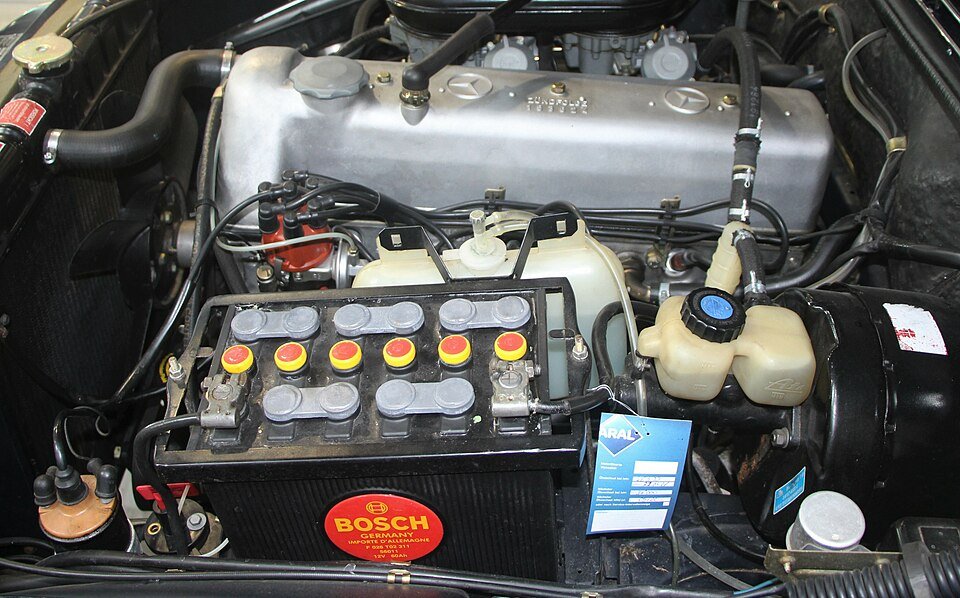
Photo: Wikisympathisant, CC BY-SA 4.0. Resized reference photograph.
Confirm the Bosch tester
“Bosch tester” is not a complete equipment description. Bosch sells different instruments, and their supported chemistries, rating ranges and additional functions vary. The model number on the device and its applicable operating instructions should appear in the job record.
Two documented examples show why this matters. These are product examples, not a claim that a particular unit is installed at our workshop. Confirm the equipment that will actually be used before booking a model-specific test.
| Documented tester | Supported battery assessment | Important boundary |
|---|---|---|
| Bosch BAT 115 | 6V and 12V lead-acid batteries, including enhanced flooded battery (EFB), gel and flat or spiral absorbed glass mat (AGM) types, within its stated rating range | Its 12V/24V starting and charging functions do not make it a 48V or traction-battery tester |
| Bosch BAT 131, cited product brochure | 6V and 12V starter lead-acid, AGM, EFB and gel batteries | Do not assume another chemistry is covered without checking the installed unit’s documentation |
Bosch’s BAT 115 specification describes a micro-load assessment and printed state-of-charge and state-of-health information. Its published operating-temperature range also matters in a hot workshop. Equipment should be used within its specified conditions, rather than treating Dubai ambient heat as permission to ignore them.
The BAT 131 product brochure distinguishes battery, starting and charging tests. It also identifies an optional current probe. An optional accessory should not be represented as fitted, and a printed report should not imply a current measurement that was never made.
Match the battery type
Mercedes vehicles can have different low-voltage arrangements. The main starter battery, a support battery and a component described by a dashboard as an auxiliary-battery fault are not interchangeable subjects. Identify the vehicle by its vehicle identification number (VIN) and identify the component that the warning concerns before selecting a test.
Even within the 12V category, chemistry matters. Flooded lead-acid, EFB and AGM batteries need the appropriate tester selection and compatible charging method. A low-voltage lithium battery must not be treated as AGM because it fits in a similar space. Unsupported battery technology requires suitable equipment and the correct procedure.
Before starting, the technician should record:
- The battery’s location and role in this exact vehicle.
- Its chemistry, nominal voltage and manufacturer identification.
- The printed capacity and starting-current rating, including the rating standard.
- Whether it was recently charged, jump-started, replaced or disconnected.
- Any visible damage, poor restraint, terminal problem or venting concern.
A rating stated under one standard must not simply be entered under another. The tester’s estimate becomes less useful when the input is wrong. Battery capacity in amp-hours and a cold-cranking rating describe different properties; neither should be substituted for the other in a menu field.
If the label is unreadable, the correct response is to establish the specification from reliable vehicle and battery information. Guessing a familiar number can make a weak battery appear better or a healthy one appear worse.
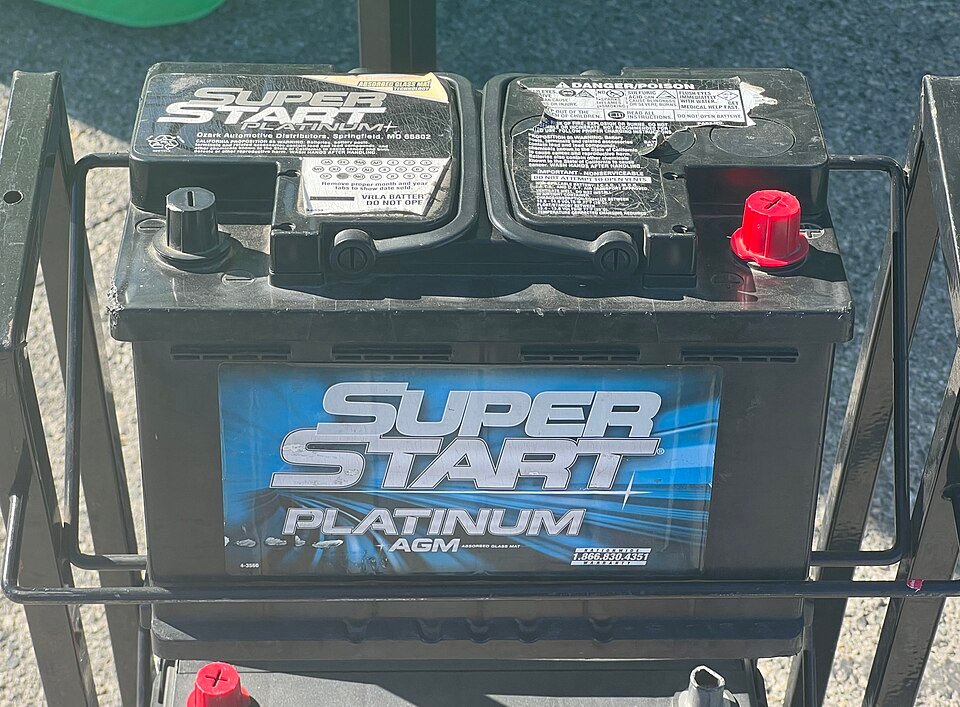
Photo: TaurusEmerald, CC BY-SA 4.0. Resized reference photograph.
Charge and health results
State of charge concerns how much charge is available now. State of health is an assessment of condition using the instrument’s method and assumptions. Neither is a direct promise that the car will start tomorrow under every possible combination of temperature, parking time and electrical demand.
An undercharged battery might still be serviceable after a suitable charge and reassessment. A fully charged battery may nevertheless have inadequate starting performance. This is why “it reads 12 volts” and “it was charged yesterday” do not settle the replacement question.
Use the two ideas separately:
- Low charge: investigate recent use, charging behavior, storage and possible discharge while parked.
- Poor assessed condition: confirm setup and follow the specified decision procedure before recommending replacement.
- Conflicting results: document the conditions, inspect connections and repeat the appropriate assessment after correcting the reason for uncertainty.
A short electronic assessment is not a full discharge-capacity test or an exact simulation of every electrical load in Dubai traffic. It can provide useful evidence quickly, but speed does not make its conclusions unlimited.
Repeated results can help a technician compare condition over time when the inputs and method are consistent. A changing percentage from different testers, temperatures or charge states is not automatically evidence of rapid deterioration.
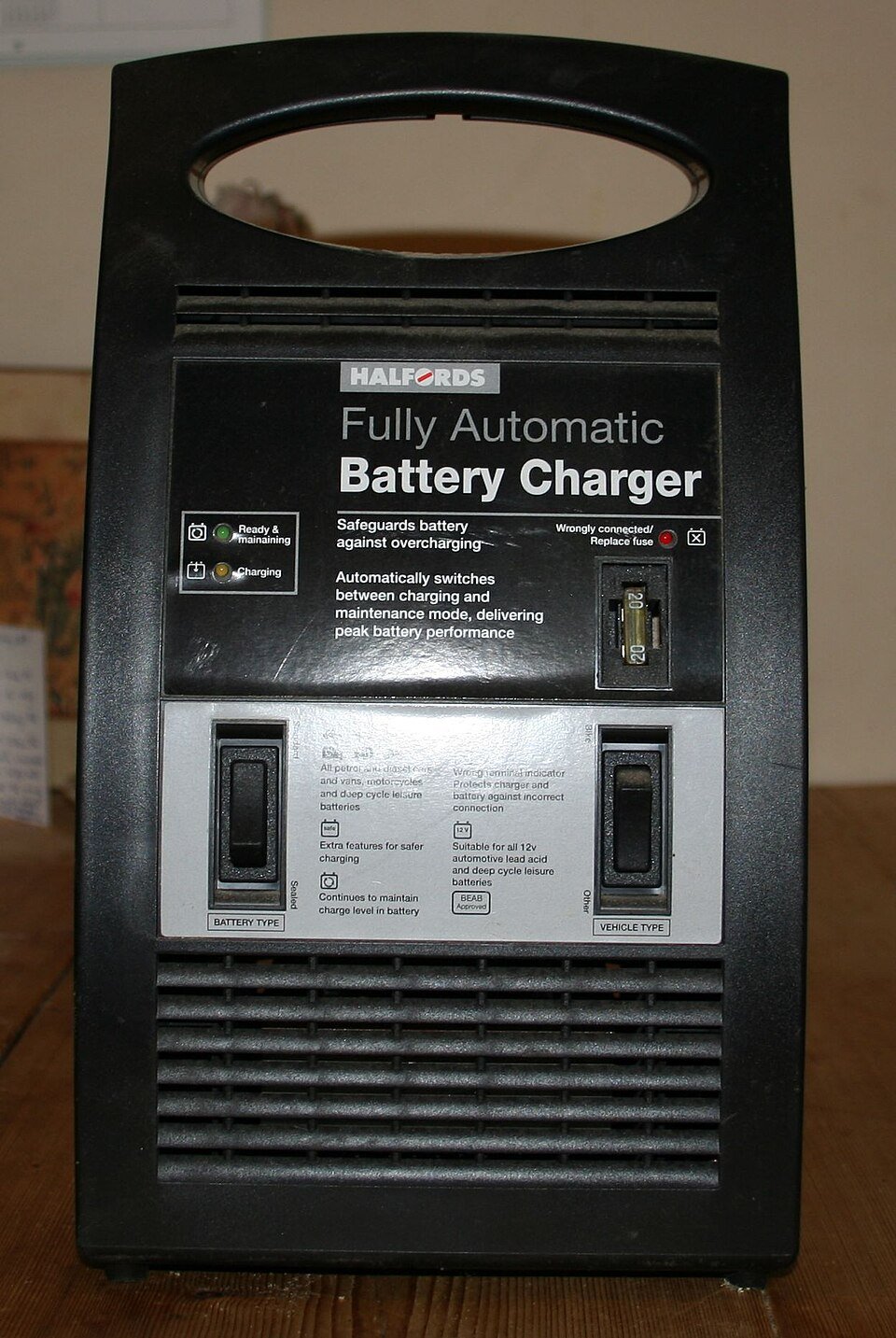
Photo: Andy / Andrew Fogg from near Cambridge, UK, CC BY 2.0. Resized reference photograph.
When to charge and retest
A charge-and-retest instruction is a separate stage of work. It is not the same as a failed battery, and it is not completed by briefly running the engine outside the workshop. Charging must suit the battery chemistry and the vehicle’s approved connection and monitoring arrangements.
A sensible sequence is:
- Confirm the battery identity, physical condition and initial test setup.
- Record the first result and why it requires further charging or investigation.
- Charge using suitable equipment and the specified safe procedure.
- Reassess after the required stabilization conditions have been met.
- Explain the resulting retain, replace or investigate decision.
Some test results indicate an internal battery defect. Others call for charging, or suggest a connection problem that affects the assessment. The technician should follow the actual tester’s instructions instead of treating every message as a sales recommendation.
Ask whether charging and the second assessment are included in the diagnostic scope. A clear answer prevents a brief initial check from being mistaken for a completed diagnosis. It also explains why a useful appointment can take longer than the instrument’s first measurement.
If the vehicle repeatedly arrives undercharged, stop treating each visit as an isolated battery event. The pattern may require charging-system checks or a parked-current investigation even if a replacement battery has already been fitted.
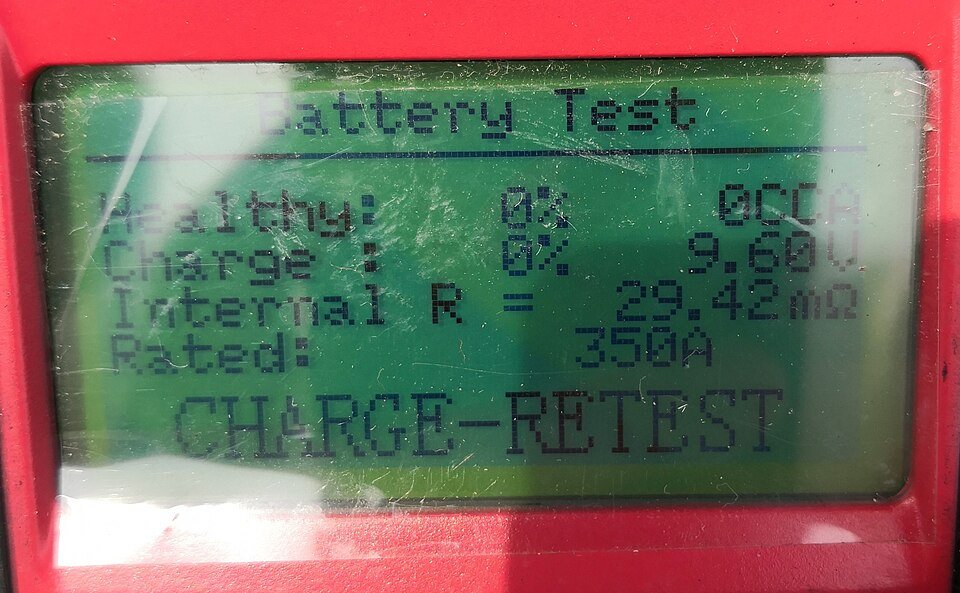
Photo: Encik Tekateki, CC0. Resized reference photograph.
Starting-system findings
The starting test concerns what happens while the engine is being cranked. A slow crank can involve the battery, cable connections, ground paths, starter or mechanical resistance. The sound alone does not identify which component failed.
A technician may need to compare supply behavior during cranking, assess voltage loss along the circuit and inspect relevant connections under load. Current measurements require appropriate equipment and interpretation. These checks should follow the exact vehicle procedure, with the vehicle secured and moving components kept clear.
| Observation | Next diagnostic question | Premature conclusion to avoid |
|---|---|---|
| Slow cranking with an undercharged battery | Does it improve after a correct charge and reassessment? | “The starter is worn out” |
| Starting complaint despite a serviceable battery | Are cable, ground and starter measurements within specification? | “The battery tester missed everything” |
| Intermittent no-crank | What authorization, supply or control evidence exists during the fault? | “Every no-start needs a battery” |
| Normal cranking but no engine start | Is the problem outside the starting-energy supply? | “A stronger battery will fix it” |
Do not repeatedly attempt to start a vehicle with smoke, hot cables or an abnormal mechanical noise. Arrange professional help. Repeated attempts can add risk and still fail to preserve the useful conditions of the original complaint.
Charging-system findings
A charging assessment asks whether the vehicle is supplying and managing electrical energy correctly under the test conditions. Mercedes charging strategies differ by generation and equipment, so one fixed running-voltage rule is not an adequate diagnosis for every vehicle.
The report should identify what was tested, whether the engine was running, which loads were applied and what the manufacturer’s procedure required. Where appropriate, further work may include wiring checks, control-system data and ripple assessment. A reading outside an expected pattern needs investigation, not an automatic alternator order.
Useful distinctions include:
- A battery can be weak even when the charging system is functioning correctly.
- A serviceable battery can become discharged because of a charging or usage problem.
- A poor connection can affect the supply without proving the charging unit itself is defective.
- A vehicle with a different electrical architecture may require tests beyond a conventional alternator check.
Similarly, a battery test does not repair flickering lights. If flicker is reproducible, the technician must trace its relationship to supply, connections, control commands and the affected lighting circuit. Replacing a battery should not be presented as a guaranteed cure before that work is done.
Separate 12V 48V and high voltage
A compatible 12V assessment can be relevant on a vehicle that also has another electrical system. It does not establish the condition of that other system. The presence of a hybrid badge, a 48V warning or an electric powertrain changes the identification and safety questions.
| System or component | Appropriate starting point | What to avoid |
|---|---|---|
| Identified 12V lead-acid battery | Compatible low-voltage tester and exact vehicle procedure | Assuming every Mercedes battery uses the same settings |
| Auxiliary or support component | Confirm its design and diagnostic procedure by VIN | Replacing it automatically with the main battery |
| 48V system | Qualified diagnosis with equipment approved for that system | Connecting a 12V battery tester to it |
| High-voltage traction system | Trained high-voltage personnel and manufacturer procedures | Owner disassembly or conclusions from a 12V printout |
Read the precise warning and follow the owner’s manual. Do not infer that a vehicle is safe to continue driving because a separate 12V test passed. Conversely, a low 12V supply should not be turned into an unsupported diagnosis of an expensive traction-battery defect.
When the battery passes
A pass is a result under recorded conditions. It does not exclude an intermittent discharge during parking, an accessory that wakes the vehicle or a fault that occurs only when hot. The next useful step is to preserve the pattern rather than replace parts until the complaint disappears temporarily.
Keep a simple symptom log:
- Date, approximate parking duration and whether the car was locked.
- Recent journey pattern, especially repeated short trips.
- Exact warning text and whether cranking was slow or absent.
- Accessories connected, including dash cameras and aftermarket devices.
- Recent repairs, charging, jump-starts or battery replacement.
Do not pull fuses randomly to find an overnight drain. Doing so can change module sleep behavior and remove evidence. A professional should establish the vehicle-specific sleep conditions and record current behavior before isolating circuits using an appropriate method.
For a flickering display, record whether other electrical equipment was affected at the same time. For a slow start, note whether it happened only after storage or also after a normal journey. These observations help direct testing without pretending that an owner’s symptom log proves a failed module.
Replacement and registration
If replacement is justified, the new battery needs the correct specification, physical fit, terminal arrangement and any required venting provision. “Higher capacity” is not automatically an upgrade, and fitting an unsupported chemistry is not a substitute for diagnosis.
The workshop should check the VIN-specific procedure for battery replacement, energy-management settings, registration, coding or initialization. These terms are not interchangeable, and not every Mercedes needs the same post-replacement operation. Ask which step applies and how its completion will be recorded.
Before authorizing replacement, request:
- The original test result and any charge-and-retest result.
- The proposed battery specification and why it matches the vehicle.
- The fitted price, tax treatment and disposal arrangements.
- Any required diagnostic or adaptation work included in that price.
- The plan to confirm the original complaint after installation.
A warning that remains after replacement deserves investigation. It should not be dismissed as something that will inevitably clear itself, nor treated as proof that every module needs a software update.
Compare repeat results
If two workshops disagree, compare the test conditions before choosing the more reassuring result. Check whether both identified the same battery, used the same rating standard and tested after an appropriate charge. A remote connection point can introduce different conditions from a permitted direct battery assessment.
Ask for the missing context:
- Was the battery recently jump-started or charged?
- Was the same chemistry and rating selected?
- Were connection concerns corrected before the final decision?
- Did the recommendation follow a completed retest or only an initial reading?
The aim is not to obtain a passing printout. It is to understand which evidence best supports a safe, proportionate decision.
Check the final report
A useful handover links the complaint, measurements and decision. It should say what was established and what remains uncertain. You should be able to distinguish “battery retained after charging” from “battery replaced” and from “further investigation required.”
| Report item | Why it helps you |
|---|---|
| VIN, mileage and battery identification | Ties the result to the correct vehicle and component |
| Tester model and settings | Makes the equipment scope and inputs reviewable |
| Conditions and separate test outcomes | Prevents a battery result being confused with a charging diagnosis |
| Recommended action and evidence | Shows why spending is justified or why replacement is unnecessary |
| Remaining checks and approval limit | Stops an open-ended investigation being mistaken for an agreed repair |
Photographs of labels and test reports can support the record, provided they are clear and belong to your vehicle. Generic equipment pictures in an article cannot establish what a workshop used on a particular job.
Battery testing questions
Can a test tell me exactly how many months are left
No. Condition assessments help with decisions, but future use, temperature, storage and faults are not fixed. Treat a claim of an exact remaining lifespan as unsupported unless its limitations are made clear. Even a serviceable battery can be discharged by a separate problem.
Should testing happen on a fixed six-month schedule
There is no universal interval established here for every Mercedes. Follow the vehicle’s maintenance requirements and arrange assessment when symptoms, storage history or other evidence justify it. A routine inspection can identify concerns without creating an automatic replacement deadline.
Will a short drive recharge a flat battery completely
Do not assume it will. The amount of discharge, battery condition and vehicle operation matter. Follow the recommended charging and retesting plan rather than using an arbitrary drive duration as proof that the battery is ready for assessment.
Is a free quick check the same as electrical diagnosis
Not necessarily. Ask what is included: battery assessment, charging, retesting, starting-circuit checks and an intermittent-fault investigation are different scopes. The value comes from the evidence and explanation, not whether a first reading was inexpensive.
Does a passing battery result make every warning harmless
No. Follow the exact dashboard instruction and investigate the system concerned. A battery printout does not override a stop message, diagnose braking or steering warnings, or prove that an unrelated electrical fault has been repaired.
Your next decision
Ask for the battery specification, tester model, setup and separate battery, starting and charging findings. Charge and retest when the procedure calls for it. Approve replacement or further diagnosis because the evidence supports it, and verify any registration requirement against the exact vehicle.
Arrange the right battery assessment
Share the exact warning, model year and recent battery history. Ask which tester will be used and which checks are included. Our Mercedes battery service explains the workshop options.